
Water in fuel is the contaminant that does diesel the most damage, and it rarely shows itself until the repair bill arrives. An OE-quality fuel filter is the last line of defence, and the workshop is the best place to catch the problem early.
When a diesel comes in with a rough idle, a rail pressure fault or an injector whose correction value has drifted, few technicians suspect water in fuel problems first. They should. Even small amounts of water can seriously damage modern injection equipment, and everyday UK driving gives it plenty of ways to get in.
How water gets in
Road diesel in the UK is made to BS EN 590. The standard allows no more than 200mg of water per kg of fuel and up to 7% biodiesel (fatty acid methyl ester, or FAME). That limit only applies when the fuel is sold. Once it’s in the car, nothing keeps it dry.
Water gets in through condensation in part-filled tanks as temperatures swing between day and night, through worn filler cap seals, and from contaminated filling station storage tanks.
FAME makes things worse in two ways. It is hygroscopic, so it attracts and holds more water than fossil diesel. It also biodegrades, so microbes can feed on it. Where free water collects at the bottom of a tank, bacteria and fungi grow where the fuel meets the water. This “diesel bug” makes slime that blocks filters and acids that corrode metal, making water in fuel a serious issue.
Common rail systems can’t cope with water in fuel
Modern common rail systems run at more than 2,000 bar, with clearances between injector needles and their guides of only a few microns. this makes them more susceptible to problems caused by water in fuel problems. Such a mix can attack these parts in three ways:
- Wear: it pushes out the fuel’s lubricating film, so pump plungers and injector needles wear quickly.
- Corrosion: it rusts steel components, and even a tiny rust pit can make a needle stick.
- Cavitation: at high pressure it can form vapour bubbles that erode nozzle holes.
Damage in one part spreads to the others. A worn high-pressure pump sheds metal into the rail, and the metal travels to the injectors. A job that began with a contaminated tank can end with a new pump, injectors and rail plus a full system flush, and the bill can easily reach four figures.
Fine water is the hard part
Large droplets that settle out are easy to deal with. Fine water mixed into the fuel (an emulsion) is much harder. Biodiesel and modern fuel additives make a water in fuel mix more easily, so the droplets are smaller, stay suspended longer and are harder to separate.
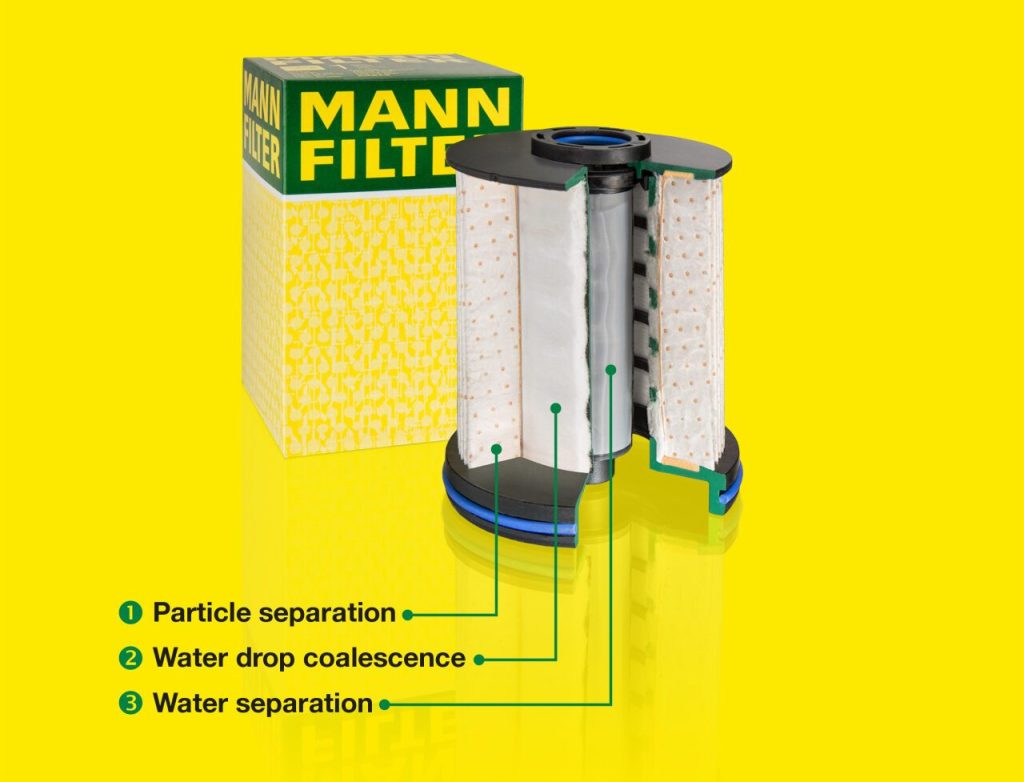
This is where filter quality matters. MANN-FILTER diesel fuel filters separate water in stages:-
- The filter media (paper) holds back solid particles.
- A coalescing layer merges fine water droplets into larger ones.
- A water-repelling barrier stops those droplets going any further, and they collect in the housing for draining.
For aftermarket parts such as the MANN-FILTER PU 11 001 z KIT, water separation stays well above 90% for the filter’s whole service life, not just when it is new. That matters. A cheaper element can perform well when new and then lose much of its water separation as it fills with dirt and gets older.
Signs to look for
Water in fuel can look like other faults, so keep it on the diagnostic list:
- On the vehicle: hard starting, rough idle, misfires, loss of power, low rail pressure codes, injector correction values out of tolerance, and a water-in-fuel warning.
- At the filter: water or a cloudy layer in the housing, rust staining, or black or brown slime, which points to diesel bug.
- In the fuel: a sample from the tank or filter, poured into a clear jar, that separates into layers, looks hazy or shows sediment.
Good workshop practice
If you believe a vehicle has a water in fuel problem, there are a number of steps you should take to ensure that no further problems are caused:
- Drain the water separator (if applicable) at every service where the design allows, and note what comes out.
- Change the filter at the manufacturer’s interval. Suggest changing it sooner on vehicles that stand for long periods, do low mileage or run on fuel from bulk tanks.
- Never pre-fill a new filter with unfiltered fuel on the clean side. Bleed the system the way the manufacturer specifies.
- Always fit new seals and check the water-in-fuel sensor and heater connections.
- If you find water, find out where it came from. Drain the tank and flush the system before fitting new parts, or the new filter will be overwhelmed.
Advise customers to keep their tanks well filled over winter to cut condensation and record any contamination on the job card. If an injector claim follows, that record protects the workshop as well as the customer.
The bottom line
Common rail systems tolerate water in fuel less than any other contaminant, and UK conditions give it plenty of ways in. An OE-quality filter such as MANN-FILTER keeps separating fine water for its whole service life. So, use an OE-Quality brand and make sure your technicians know the warning signs. That’s the cheapest protection a diesel owner can buy.



You must be logged in to post a comment.